
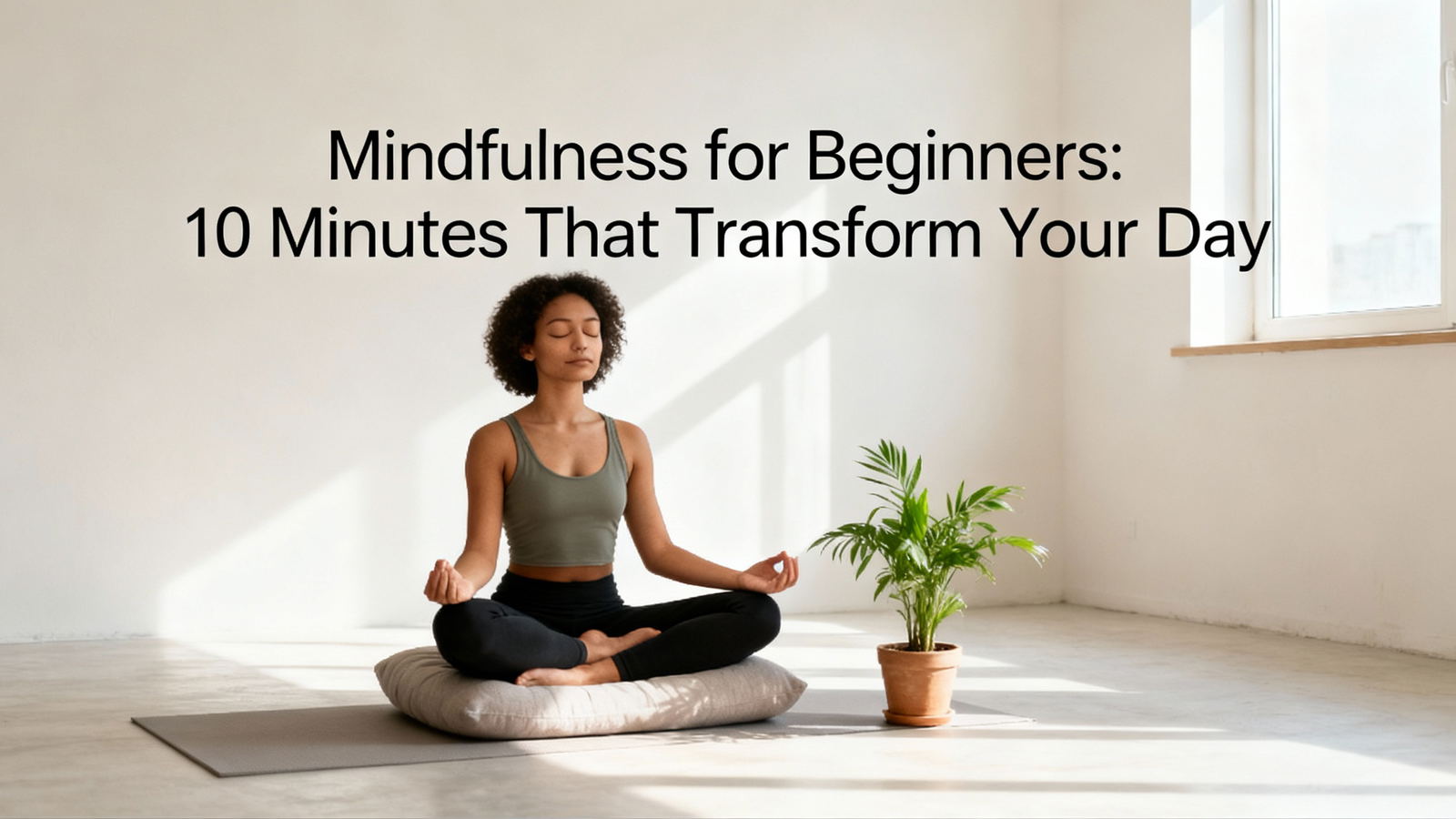
Mindfulness for Beginners: 10 Minutes That Transform Your Day
It's Not Meditation: How to Practice Without Changing Your Routine
Do you often find yourself saying, "I don't have time for mindfulness"? You're not alone. In our fast-paced world, the idea of adding another task to an already overflowing schedule can feel overwhelming. Many people mistakenly believe that mindfulness requires hours of silent meditation, a serene environment, or a complete overhaul of their daily lives. This misconception often prevents us from exploring a practice that could significantly enhance our well-being.
Consider this: a landmark Harvard study revealed that on average, people spend 47% of their waking hours thinking about something other than what they're doing, with a significant portion of that time dedicated to worrying about the future (47). This constant mental chatter, often referred to as "mind-wandering," is a primary source of stress, anxiety, and reduced productivity. It keeps us from fully experiencing and appreciating the present moment, which is, ironically, the only moment we truly have.
But what if I told you that you could reclaim a significant portion of your mental peace and focus with just 10 minutes of mindfulness practice a day? This article isn't about asking you to become a monk or to drastically alter your routine. Instead, it's about showing you how to weave simple, powerful mindfulness techniques into the fabric of your existing day, transforming your experience from one of constant distraction to one of focused presence and calm. Get ready to discover how a few minutes can make a world of difference.
Before we dive into the practical applications, let's clear up some common misunderstandings about mindfulness. It's crucial to understand what mindfulness isn't so you can embrace what it is without preconceived notions.
What Mindfulness ISN'T:
- It's not a religion or spiritual dogma. While many spiritual traditions incorporate mindfulness, the practice itself is secular and accessible to everyone, regardless of their beliefs.
- It's not about hours of sitting in uncomfortable positions. While formal meditation often involves sitting, mindfulness can be practiced anywhere, anytime, and in any posture.
- It's not about emptying your mind or stopping your thoughts. This is perhaps the biggest misconception. Our minds are designed to think. Mindfulness isn't about silencing thoughts, but rather about observing them without judgment, recognizing them as transient mental events, and choosing not to get carried away by them.
- It's not about achieving a state of bliss or perpetual calm. While peace can be a byproduct, the primary goal is awareness and acceptance of whatever is happening in the present moment, pleasant or unpleasant.
What Mindfulness IS: At its core, mindfulness is the practice of intentionally bringing your attention to the present moment, without judgment. It's about noticing your thoughts, feelings, bodily sensations, and the surrounding environment with an attitude of open curiosity and acceptance. It's about being fully awake and aware of your experience as it unfolds, rather than being lost in thought about the past or future.
The Neuroscience Behind Mindfulness: The benefits of mindfulness aren't just anecdotal; they're backed by robust scientific research. Neuroimaging studies have shown that regular mindfulness practice can actually change the structure and function of your brain.
- Prefrontal Cortex Activation: Mindfulness strengthens the prefrontal cortex, the part of the brain responsible for executive functions like planning, decision-making, and emotional regulation. This means improved focus, better impulse control, and enhanced problem-solving abilities.
- Amygdala Downregulation: Simultaneously, mindfulness helps to quiet the amygdala, often referred to as the brain's "fear center." The amygdala is responsible for our fight-or-flight response. By reducing its overactivity, mindfulness helps us respond to stress more calmly and thoughtfully, rather than react impulsively.
- Increased Gray Matter: Studies have even shown an increase in gray matter density in areas associated with learning, memory, emotion regulation, and perspective-taking. This indicates that mindfulness isn't just a temporary state; it's a skill that can literally reshape your brain for greater resilience and well-being.
Understanding these fundamental principles and the science behind them can empower you to approach mindfulness for beginners with confidence, knowing that even 10 minute mindfulness practices can yield profound, lasting benefits.
When stress hits, our breath often becomes shallow and rapid, signaling to our nervous system that we're in danger. By consciously regulating our breath, we can reverse this signal, activating the parasympathetic nervous system (our "rest and digest" mode) and promoting a sense of calm. These stress reduction techniques are perfect for quick relief.
Developed by Dr. Andrew Weil, this technique is a powerful natural tranquilizer for the nervous system. It's excellent for calming anxiety, falling asleep, or quickly de-stressing.
How to Practice:
- Step 1: Find a comfortable position, sitting or lying down. Place the tip of your tongue against the ridge of tissue just behind your upper front teeth, and keep it there through the entire breathing process.
- Step 2: Exhale completely through your mouth, making a gentle "whoosh" sound.
- Step 3: Close your mouth and inhale quietly through your nose to a mental count of four.
- Step 4: Hold your breath for a count of seven.
- Step 5: Exhale completely through your mouth, making a "whoosh" sound, to a count of eight.
- Step 6: This completes one breath. Inhale again and repeat the cycle three more times for a total of four breaths.
When to Use:
- Before a stressful meeting or presentation.
- When you feel anxiety rising.
- To help you fall asleep quickly.
- After a challenging conversation.
Often used by Navy SEALs to maintain focus and calm in high-stress situations, box breathing is simple yet incredibly effective for regaining control and clarity.
How to Practice:
- Step 1: Find a comfortable position.
- Step 2: Exhale all the air from your lungs, creating an empty canvas for your breath.
- Step 3: Inhale slowly through your nose for a count of four. Feel your belly expand.
- Step 4: Hold your breath for a count of four.
- Step 5: Exhale slowly through your nose for a count of four. Feel your belly contract.
- Step 6: Hold your breath (lungs empty) for a count of four.
- Step 7: Repeat this "square" pattern for 3-5 minutes.
When to Use:
- When you need to regain focus and concentration.
- During moments of intense pressure or decision-making.
- To calm your nervous system after an adrenaline rush.
- As a quick reset during your workday.
This technique is a natural way our body releases tension, and we can consciously harness it for immediate relief. It's a quick, discreet way to reset.
How to Practice:
- Step 1: Take a deep, audible inhale through your nose, filling your lungs completely. You might even take a second, smaller inhale at the very top of the first one, as if trying to squeeze in a little more air.
- Step 2: Let out a long, slow, audible sigh through your mouth, allowing all the tension to release with the breath. Make a sound if it feels natural.
- Step 3: Notice the feeling of release in your body.
- Step 4: Repeat 2-3 times.
When to Use:
- When you feel overwhelmed or frustrated.
- After completing a difficult task.
- To transition between activities.
- Anytime you feel a build-up of physical or mental tension.
These breathing exercises are powerful tools for mindfulness for beginners, demonstrating that even a few conscious breaths can be a profound form of 10 minute mindfulness and effective stress reduction techniques.
"Micro-Practices" That Fit Any ScheduleThe beauty of mindfulness for beginners lies in its adaptability. You don't need to carve out large blocks of time. Instead, you can integrate "micro-practices" – short, intentional moments of awareness – into your existing routine. These small shifts can accumulate into significant mindfulness benefits over time.
Waiting for the Elevator: The Body ScanInstead of pulling out your phone or mentally rehearsing your next meeting, use these few moments to connect with your body.
- The Practice: As you wait, gently close your eyes (if comfortable) or soften your gaze. Bring your attention to your feet. Notice the sensation of your feet on the floor, the pressure, the temperature. Slowly move your awareness up through your ankles, calves, knees, thighs, hips, torso, arms, hands, neck, and finally your head. Notice any tension and, without judgment, simply acknowledge it. This brief body scan helps ground you in the present moment and can reveal areas of tension you might not have noticed.
Traffic jams are notorious stress triggers. Instead of letting frustration build, use the opportunity to practice mindful listening.
- The Practice: Roll down your window slightly (if safe and comfortable). Close your eyes or fix your gaze on a point. Bring your attention to the sounds around you. Notice the hum of engines, the distant sirens, the chirping of birds, the rustle of leaves. Don't label them as "good" or "bad," "annoying" or "pleasant." Simply observe the sounds as they arise and pass, like waves on a shore. This practice helps to detach from the narrative of frustration and connect with the sensory experience of the present.
Meetings can often feel like a whirlwind of information and demands. Taking a moment beforehand can help you approach them with greater clarity and purpose.
- The Practice: Before entering a meeting room or logging into a virtual call, take one minute. Close your eyes or look down. Take three deep, slow breaths. As you breathe, silently set an intention for the meeting. It could be: "My intention is to listen actively," "My intention is to contribute constructively," or "My intention is to remain calm and focused." This simple act helps to center your mind and align your actions with your values, making you more present and effective.
Your lunch break is often rushed, eaten at your desk while scrolling. Transform it into a nourishing experience for both body and mind.
- The Practice: Before taking your first bite, pause. Look at your food. Notice its colors, textures, and shapes. Take a deep breath and smell the aromas. As you take your first bite, chew slowly and deliberately. Notice the taste, the texture, how it feels in your mouth. Pay attention to the act of swallowing. Put your fork down between bites. Notice when you feel satisfied, rather than just full. This mindful eating practice not only enhances your enjoyment of food but also improves digestion and helps you recognize your body's hunger and fullness cues.
These micro-practices are perfect examples of how 10 minute mindfulness can be seamlessly integrated into a busy day, offering powerful stress reduction techniques and unlocking significant mindfulness benefits without requiring extra time.
Proven Benefits (Cite Studies)The growing body of scientific evidence supporting mindfulness is compelling. Far from being a fleeting trend, the mindfulness benefits are well-documented and impact various aspects of our physical and mental health. These studies provide a strong foundation for why mindfulness for beginners is a valuable investment of your time, even if it's just 10 minute mindfulness sessions.
- Reduced Cortisol Levels: One of the most significant benefits is its impact on stress hormones. A study published in the Journal of Psychosomatic Research found that individuals practicing mindfulness experienced a 23% reduction in cortisol levels. Cortisol, the primary stress hormone, can lead to numerous health issues when chronically elevated, including weight gain, weakened immune function, and increased risk of heart disease. By lowering cortisol, mindfulness directly contributes to better physical health and resilience against stress.
- Improved Focus and Attention: In our distraction-filled world, the ability to focus is a superpower. Research published in the Mindfulness Journal demonstrated that regular mindfulness practice led to a 31% improvement in focus and attention. This is attributed to the strengthening of the prefrontal cortex, which is responsible for executive functions. For professionals, this translates to enhanced productivity, better decision-making, and reduced errors.
- Better Emotional Regulation: Mindfulness helps us observe our emotions without being overwhelmed by them. fMRI studies have shown that mindfulness training leads to structural and functional changes in the brain, particularly in the amygdala (the brain's fear center) and its connections to the prefrontal cortex. These changes result in improved emotional regulation, meaning we can respond to challenging situations with greater calm and less reactivity. Instead of being swept away by anger or anxiety, we gain the capacity to pause, observe, and choose a more skillful response.
- Improved Sleep Quality: Sleep is fundamental to health, yet many struggle with insomnia or poor sleep quality. A review published in Sleep Medicine Reviews concluded that mindfulness-based interventions are effective in improving sleep quality, particularly for individuals with chronic sleep disturbances. By reducing rumination and anxiety, mindfulness helps quiet the mind before bed, making it easier to fall asleep and stay asleep. This is a crucial mindfulness benefit for overall well-being.
- Enhanced Empathy and Compassion: Beyond individual benefits, mindfulness can also improve our relationships. Studies indicate that mindfulness practice can increase activity in brain regions associated with empathy and compassion. By becoming more aware of our own internal states, we develop a greater capacity to understand and connect with the experiences of others, fostering stronger, more meaningful relationships.
These scientifically validated mindfulness benefits underscore why incorporating even brief stress reduction techniques into your daily life can have a profound and positive impact on your mental, emotional, and physical health.
Recommended Apps for BeginnersFor those new to mindfulness, technology can be a fantastic ally. Mindfulness apps offer structured guidance, guided meditations, and convenient access to practices, making mindfulness for beginners more accessible than ever. Here's a brief overview of some top choices:
Headspace- Best for Structure: Headspace is renowned for its clear, progressive learning path. It offers themed courses (e.g., "Stress," "Sleep," "Focus") that build foundational skills step-by-step. Its signature animated videos explain concepts in an engaging way.
- Key Features: Guided meditations, sleep sounds, focus music, "SOS" meditations for immediate relief.
- Cost: Subscription-based with a free trial.
- Best for Sleep: Calm is famous for its "Sleep Stories" – bedtime tales narrated by soothing voices (including celebrities) designed to lull you to sleep. It also offers a wide range of guided meditations and breathing exercises.
- Key Features: Guided meditations, Sleep Stories, nature sounds, masterclasses on mindfulness topics.
- Cost: Subscription-based with a free trial.
- Free with Largest Library: Insight Timer boasts the largest free library of guided meditations (over 100,000) from thousands of teachers worldwide. It also includes ambient music, talks, and a meditation timer.
- Key Features: Extensive free library, customizable meditation timer, community features, courses (some paid).
- Cost: Mostly free, with an optional paid subscription for premium features and courses.
- Short Sessions for Busy People: True to its name, Simple Habit specializes in short, 5-minute guided meditations designed for specific situations (e.g., "Before a Meeting," "Commute," "Feeling Anxious"). It's perfect for integrating 10 minute mindfulness into a packed schedule.
- Key Features: Short guided meditations, specific situation-based meditations, diverse teachers.
- Cost: Subscription-based with a free trial.
- Headspace:
- Learning Path: Structured courses
- Sleep Focus: Sleepcasts, sleep music
- Free Content: Limited trial
- Best For: Learning fundamentals, structured progression
- Calm:
- Learning Path: Themed programs
- Sleep Focus: Sleep Stories (very popular)
- Free Content: Limited trial
- Best For: Sleep, relaxation, soothing voices
- Insight Timer:
- Learning Path: Vast library, less structured
- Sleep Focus: Sleep music, guided sleep meditations
- Free Content: Extensive free library
- Best For: Variety, experienced meditators, budget-conscious
- Simple Habit:
- Learning Path: Situation-specific
- Sleep Focus: Some sleep meditations
- Free Content: Limited trial
- Best For: Quick breaks, busy schedules, targeted relief
These apps can be invaluable tools for anyone looking to explore mindfulness for beginners and integrate stress reduction techniques into their daily life, making the journey to experiencing mindfulness benefits much smoother.
Case Study - The Executive Who Reduced Anxiety by 40David initially dismissed mindfulness as another "fluffy" wellness trend. However, after a particularly stressful quarter, his doctor suggested exploring mindfulness for beginners as a stress reduction technique. Reluctantly, David decided to give it a try, specifically looking for practices that fit his demanding schedule.
His solution was a combination of 10 minute mindfulness practices:
- Morning Routine: He committed to a 10-minute morning routine (which we'll detail in the next section) before checking his phone.
- Micro-Practices: Throughout his day, he integrated micro-practices. He used "box breathing" before important client calls, practiced mindful listening during his commute, and took a "mindful sigh" whenever he felt overwhelmed. He even started practicing mindful eating during his lunch break, stepping away from his desk for just 15 minutes.
The results after just 8 weeks were remarkable. David reported a 40"> reduction in his anxiety levels
, as measured by a standardized anxiety questionnaire. He found himself sleeping more soundly, his irritability decreased, and he felt a greater sense of control over his emotions. Crucially, his colleagues noticed a change too; he was calmer in meetings, more patient with his team, and his decision-making seemed sharper.David's transformation wasn't about adding more to his plate; it was about changing how he engaged with his existing plate. He learned that mindfulness wasn't about escaping his busy life, but about being more present within it. As David himself put it, "The biggest change was realizing I could be busy AND present. It wasn't about finding more time, but about making the time I had more meaningful." His story is a powerful testament to the profound mindfulness benefits that even short, consistent practices can bring to a demanding professional life.
Your 10-Minute Morning Routine (Step-by-Step)Starting your day with intention can set a positive tone for the hours ahead. This 10 minute mindfulness routine is designed to be simple, effective, and easily integrated into even the busiest mornings. It's a perfect example of mindfulness for beginners that delivers significant mindfulness benefits.
- Minute 1-2: Wake Up Without Your Phone
- Instead of immediately grabbing your phone to check emails or social media, resist the urge. Allow yourself to simply be awake. Notice the sounds in your environment, the light in the room, the feeling of your bedsheets. This simple act prevents your day from starting in a reactive, overwhelmed state.
- Minute 3-4: Gentle Stretching and Body Awareness
- While still in bed or standing beside it, engage in some gentle stretches. Reach your arms overhead, twist gently from side to side, or do some neck rolls. As you stretch, bring your attention to the sensations in your body. Notice any stiffness, tension, or areas of comfort. This connects you to your physical self before the mental demands begin.
- Minute 5-7: Breathing Practice (Choose from Section 2)
- Find a comfortable seated position. Close your eyes or soften your gaze. Choose one of the breathing techniques from Section 2 (e.g., "4-7-8 Breathing" or "Box Breathing"). Focus entirely on the rhythm and sensation of your breath for these three minutes. If your mind wanders, gently guide it back to your breath. This is your anchor to the present moment.
- Minute 8-9: Intention Setting for the Day
- With your eyes still closed or gaze soft, reflect on the day ahead. What is one quality or intention you want to bring to your day? It could be "patience," "focus," "kindness," or "productivity." Silently repeat this intention to yourself a few times. Visualize yourself embodying this quality throughout the day. This proactive step helps you navigate challenges with purpose.
- Minute 10: Gratitude Moment
- Before fully engaging with your day, take a moment to identify three things you are genuinely thankful for. They can be big (your health, your family) or small (the taste of your coffee, a sunny window, a comfortable bed). Feel the emotion of gratitude in your body. This practice shifts your perspective towards positivity and abundance.
This 10 minute mindfulness morning routine is a powerful way to cultivate mindfulness benefits and set a foundation of calm and focus before the demands of the day take over. It's a practical stress reduction technique that anyone can adopt.
BONUS: Audio Guide OfferReady to experience the power of 10 minute mindfulness for yourself? We've created a special resource just for you.
Download our free 10-minute guided mindfulness audio! This audio guide will walk you through a simple yet profound practice, helping you to calm your mind, reduce stress, and cultivate presence. It's the perfect companion for your morning routine or for a quick reset anytime you need it.
[Click Here to Download Your Free 10-Minute Guided Mindfulness Audio]
ConclusionYou've now seen that mindfulness for beginners isn't an elusive, time-consuming practice reserved for gurus. It's an accessible, science-backed approach to living with greater awareness, calm, and purpose. From understanding its core principles and neurological impacts to implementing quick breathing exercises and "micro-practices," you have the tools to begin transforming your daily experience. The mindfulness benefits – reduced stress, improved focus, better emotional regulation, and enhanced sleep – are within your reach, requiring only a small, consistent commitment.
Remember David, the marketing director who found a 40% reduction in anxiety by weaving 10 minute mindfulness into his busy life. His story, and the scientific evidence, underscore a powerful truth: you don't need more time; you need more presence. Start small. Pick just one micro-practice from this article and try it today. Notice the difference it makes. The journey to a more mindful life begins with a single, conscious breath.
The present moment is the only moment we ever have. Let's make it count.
E você ainda recebe 2 bônus especiais:
Para acelerar ainda mais o seu resultado!
Planilha de Calculo de Produção
Lorem ipsum dolor sit amet, consectetur adipiscing elit. Ut elit tellus, luctus nec ullamcorper mattis, pulvinar dapibus leo.
Planilha de Calculo de Produção
Lorem ipsum dolor sit amet, consectetur adipiscing elit. Ut elit tellus, luctus nec ullamcorper mattis, pulvinar dapibus leo.
Depoimento de nossos alunos:
Em breve o seu depoimento também estará aqui para todos verem o seu sucesso!


SOBRE FULANO DE TAL
Fulano de Tal trilha uma grande jornada como desenvolvedor profissional há 20 anos. Reconhecido pelo seu canal no Youtube através do curso Vue.js do jeito ninja, o mais assistido da plataforma com mais de 200 mil visualizações.
Conheceu o mundo da programação com apenas 16 anos e depois fundou a sua própria agência digital onde chegou a desenvolver mais de 100 projetos web para todo tipo de empresa.

GARANTIA DE 7 DIAS COM RISCO ZERO!
Ainda não tem certeza? Não se preocupe.
Se o conteúdo descrito acima não for o mesmo que você receber, você tem 7 dias de garantia e devolverei seu dinheiro sem burocracia!
Lembrando que seu acesso a plataforma é vitalício e sempre estamos incluindo novas aulas.
APROVEITE ESSA
OPORTUNIDADE!
E comece a aprender tudo sobre...
12x de R$ 28,94*
ou a vista por R$ 297,00

Dúvidas Frequentes
1 - São aulas gravadas ou ao vivo?
2 - Até quando terei acesso ao curso?
3 - É presencial ou online?
4 - Título a mostrar/esconder
5 - Posso fazer download das aulas?
6 - Quais são as formas de pagamento?
São aceitos todos os tipos de cartão, além de boleto. Compras realizadas no cartão de crédito são processadas de forma quase instantânea.
Lembrando que pagamentos via boleto podem demorar até 72h para que o
banco identifique e confirme o pagamento.
7 - Como será o suporte de dúvidas?
8 - A plataforma recebe atualizações?
9 - Título a mostrar/esconder
10 - Título a mostrar/esconder
Ainda está com alguma dúvida?
Converse comigo pelo Whatsapp
©2026 - Todos os Direitos Reservados
Politica de Privacidade
Termos de Uso